Welcome!

I believe that each of us is endowed with a font of creative energy. If we are lucky we find both an outlet for that energy and the time and means to create. For the past ten years or so I have been designing and building furniture and other things from wood. I think I have some aptitude for it, and like anything, practice has improved my skills. I really don’t know how my work stacks up with what else is out there – what I do know is that I thoroughly enjoy the entire process – from conceptual design, the trigonometry most of us forgot before high school graduation, joinery, and finishing. Wood is a complex substance with a wonderful spectrum of scents, feel, and looks, and I derive great satisfaction from working with it to create objects that are functional, durable, and pleasing to the eye and touch - to me it is the perfect blend of the aesthetic and the practical. I set this blog up to allow my family and friends to see some of what I have done from across the thousands of miles that may separate us. Comments are always appreciated.

Spring 2011 - Torii Gates


Our friend Julianne McGuinness, Executive director of the Alaska Botanical Garden, asked me to submit something for the annual ABG Gala, their big fundraiser.  These two creations are the result.  Traditional Chinese and Japanese design has had a pretty big influence on the early 20th century American furniture styles that inform a lot of my work, and this was a chance to explore the unique form of a Torii gate, an icon of Japanese temple architecture.  When installed at a temple entrance they serve to mark the trasition from the profane to the sacred.  The exact meaning, origin, and derviation of the Torii gate design is apparently lost to history, but they are quite evocative regardless.

I chose to hang two traditional symbols from the gates, pierced relief carved into large disks.  The one in the first two pics is Japanese lettering for "tranquility", or so the internet says.  I know no Japanese so I'll have to assume it is correct.  Even if it's not, I still love the lines.  The second is a pretty obvious one, yin and yang, or positive and negative.  The gates are made of western red cedar that I bought at the local chain big-box harware stores and machined as needed.  The disks were shaped using a system I dreamed up that amounts to a (really) poor man's lathe in which I punded a nail through a board, clamped that board to a work bench with the nail sticking straight up, drilled a hole in the exact center of the cedar disk and used my Granddad's massive disk sander to both spin the disk on the nail and remove material, pushing my leg into the piece as a brake if it got going too fast.  To my utter astonishment, it actually works pretty well.
It was great fun attending the gala as a "featured artist" (whoda ever thunk it), and I actually made my first sale in the history of my hobby, to a lovely couple in East Anchorage, for $1900!  Honestly, given the hours I put into these things, that amounts to chump change if I were paying myself an hourly wage, but then I never got into this as a way to get rich.  There are lots of guys out there with a lot more talent and skill than I have who barely make ends meet trying to do this a profession.  Kind of too bad, but that's the way it is.  Anyway, in this case it's all immaterial anyway since I donated all the proceeds to the gardens.  As I am fond of mentioning, I just like to build stuff....


Spring 2011 - Hawaiian Trivets

We visited the Big Island of Hawaii in February 2011 for something like the seventh time over the past 10 years or so. I picked up these tiles there, and when I got home I made two trivets - one for us and one for our lovely hosts in Hawaii, Pam and Roger Robinson. They're made of mango (which I brought back from Hawaii on a previous trip), maple, and mahogany with walnut splines.


I am always inspired when we go to Hawaii.  There are some really amazing artists working in wood there, and their work is featured in several galleries throughout the island.  If you ever go and are so inclined, the two best places to visit to view the stunning work these folks create are the Volcano Art Center adjacent to the Kilauea Visitor Center in Hawaii Volcanoes National Park and if you're fortunate to be there when it's on, the annual exhibit of the Hawaii Woodworkers Guild in late January-February at the Isaacs Art Center in Waimea.

One of the members of the guild is a friend and neighbor of Pam and Roger's, Alex Franceschini.  He built a HUGE and amazingly well equipped shop under his house, and there are few more enjoyable activities I've engaged in recently than to stop by his house and work with him in his shop, with all the doors open, the tropical breezes wafting through, and piles of mango, koa, and other exotic local woods just waiting to be turned into something.  He not only has a pretty amazing set of tools, but also the skills to use them and to keep them in top operating condition.  As I've mentioned in earlier posts, of late I've been spending more and more time learning about the proper use of hand tools, and I spent a thoroughly enjoyable couple of hours under Alex's tutelage learning the finer points of hand planing, scraping, and tool sharpening.  How generous with both his tools and his time!  I look forward to working with him again - to the point where I would probably return to Hawaii just for the privilege of working with him in his shop again.

Spring 2010 - Spring 2011 - A Cherry Desk


This desk took over a year to build.  I started in the Spring of 2010,  took the summer off and completed it the following Spring.

It's more overtly oriental than any of my previous pieces.  The design is completely original, and I'm not totally sure I know where it came from - creativity can be such a deeply mysterious, almost mystic process - I just knew I wanted something completely unique.  I think it might have stemmed from an idea I had after seeing the detail of the recessed door pull in a friend's custom bed side table coupled with my experience building the coffee table after the design of my sister's VERY overtly oriental table (see below).


My "design process" usually involves nothing more complicated than rough pencil sketches on scrap paper.  Surprisingly, it works.  This time though, I tried something different - a free software program by Google called "Sketchup".  It allows for modeling in 3-D, the ability to rotate the model to show any face, and can be dimensioned to any degree of precision desired.  I think that for the smaller projects the pencil sketches is still the way to go, but for the more involved projects, or anything where a 3-D model would be helpful to visualize the design, or perhaps as an aid in working with a prospective client on a comission, Sketchup can be a useful, powerful, and pretty entertaining tool with which to work out a design.

The desk is made of cherry with accents of maple and walnut.  The drawer cases as well as the drawers themselves are joined with dovetails, made using my neighbor's Leigh D4 Dovetail Jig.  This was my first experience with a dovetail jig, and to be honest it was a bit trying.  I suppose alot of it is that anything new takes time to master, but man, I struggled.  However I did persevere, and I would rate this as my finest piece yet.


Late 2009 - Two Foot Stools

 Corinne wanted a foot stool for our little cabin in Talkeetna.  I was looking for a project, so these were the result.

Made of mahogany, they feature legs that are tapered on all four sides, allowing me to experiment with non-standard mortise and tenon joinery.  Most of the time builders "cheat" by only tapering the outside surfaces, but I was interested in making things a little more challenging - it's the best way to learn new things.


I also took the opportunity to further explore the raised detailing I first worked with on my side table (featured on a previous post).  Fussy, yes - but again, that's how one learns, and I do this for enjoyment after all - not expedience.

These stools were even more of a collaboration than usual.  On every project I avail myself of Corinne's ideas regarding design, form, and function, and invariably the finished piece is better for the inclusion of her ideas.  With these, not only were they her idea to start with, but she collaborated on the design and fabricated the cushions.  So she got her footstool at our Talkeetna cabin and its twin lives in our living room in Anchorage.


Late 2008-Early 2009 - An End Table to Match


Having been so taken with the coffee table I created the year before, I made an end table to match it.  It incorporates the same leg style, cloud lift spreaders, and square walnut plugs, as well as  the seamed top with the butterfly splices.

On this piece I included a small pen and pencil drawer under the top and got a little carried away with a bloodwood and lacewood detail on the drawer front.  I think it really sets the piece off.

At this point I think I've hit on a standard finish for my projects:  Two coats of Watco Natural Danish Oil, and on high-use surfaces, three or four coats of Minway Rub-On Polyurethane on the high-use surfaces, and finally, paste wax buffed to whatever level of shine I desire.  There are certainly many other ways to finish fine furniture (if that's what I can call my work), but this seems to me to represent the best combination of natural beauty, ease of application, and long life.


Early 2008 - A Coffee Table

In the summer of 2007 we took a raft trip down the East Fork of the Chulitna with our Talkeetna friends and spent a night at a place that has the most amazing collection of river-washed rocks. In the midst of carousing I had the idea of using some of those rocks in a coffee table so I brought back a whole mess of them (which incidentally and for the record pales in comparison to the volume & weight of what most of of our friends brought out). Then in January/February 2008 we had a most enjoyable vacation in California and Arizona - and while in California we stayed at my sister Mary's house in LA. Two things while we were there - we went to the Gamble House in Pasadena, regarded as THE outstanding example of Greeene and Greene archtecture/design (they being Charles and Henry - leading lights of the early 20th century Arts and Crafts movement), and we spent several mornings and evenings in my sister's living room which featured a coffee table custom built for them that was derived from more or less the same style as what we had just seen in Pasadena. Suddenly it all came into focus... and shortly after we returned to Alaska my design was more or less complete.
The size and dimensions are pretty close to what is in my sister's living room, the "cloud lifts" (the offsets in the horizontal spreaders) are stolen from both Greene and Greene and the guy who built my sister's table, the square plugs are both a Greene and Greene touch and what I previously explored in my dining room table, and the choice of materials - mahogany and walnut - I've used on several other pieces. AND I used the Chulitna River Rocks....
This little detail roughly doubled the time I spent on the project, but it was a really interesting exercise, allowed me to stay true to my goal of stretching my boundaries with each project, and I think added greatly to the aesthetics of the finished piece. It's certainly unique....
I've been getting more and more comfortable with chisels, and wanted to incorporate a classic Arts and Crafts detail, the butterfly splice, into my table. Even in as close a detail as shown above, it actually looks okay! The butterfly itself is lacewood.

With this project I really think I've elevated my hobby to a new level. Every joint on this piece fit perfectly and honestly, I think it would have been almost as stable if I hadn't used any glue at all! Most rewarding...

The finish is oil with two coats of rub-on polyurethane on the table and shelf tops, and wax.

Late 2007 - Jewelry Boxes

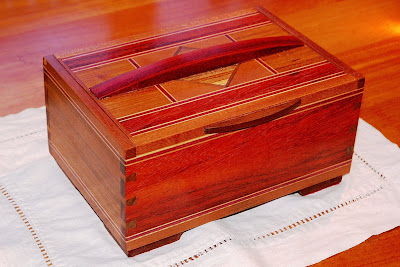
I don't now recall what made me decide to try my hand at boxes. I do know that of late I've been very interested in detail, and a box affords the opportunity to showcase one's attention to detail. At the library I found a fascinating book called "400 Boxes" that is, as the title suggests, a book featuring 400 hand-made boxes. There are some truly wonderous creations there - and it makes me realize how much farther one could take this (if one had all the time in the world, of course).
The boxes were made primarily of padouk and canarywood, with accents of maple, purpleheart, bloodwood, walnut, zebrawood, and ipe.

This project was my first use of dovetails - the classic woodworking joint. They're a time consuming and exacting process (and that's saying something coming from a guy building furniture in his spare time). These were rough-cut with a table saw and finished with chisels. If I made them on a regular basis I would buy a jig for use with a router - and who knows? maybe someday I will.With each project I seem to be using hand tools more and more, which is gratifying. What one can do with a couple of sharp chisels can't be duplicated by machine, and chisels, files, and a block plane are perfect for ensuring proper fitting of the myriad parts and pieces that go into my projects these days. AND there's less dust. AND I get to listen to music and maybe even sip on a beer while I work - luxuries not afforded with power tools.